Adjustable Discharge Gap in Laboratory Jaw Crushers: Controlling Particle-Size for Robust End-to-End Mineral Sample-Preparation
Just another WordPress site
Press Release Disclaimer: This is a press release distributed through the XPR Media network. It has not been independently verified by our newsroom.

Qingdao, Shandong, China – November 28, 2026
Against global advances in ISO/IEC 17025-compliant mineral-testing, geochemical exploration and responsible commodity-trade governance, complete sample-preparation workflows demand controlled particle-size reduction at every processing stage.
Primary coarse crushing represents the very first unit-operation after field-collected rock-core and lump-ore material enters the laboratory. Many facility managers focus heavily on crusher throughput and jaw-plate wear resistance, while underestimating how adjustable discharge-gap performance cascades across downstream splitting, homogenisation, pulverising and final assay measurement. Fixed-gap laboratory jaw crushers deliver only one narrow particle-size window, frequently creating workflow bottlenecks: under-crushing causes recurring downstream equipment blockages; excessive over-crushing generates unwanted ultra-fine fractions that bias precious-metal and trace-element test outcomes.
This article explains how controlled primary-crushing particle-size lays the ground-work for reliable subsampling and assay reproducibility, analyses real-world laboratory failure modes, compares practical gap-adjustment mechanisms, maps performance against common mineral-lab workflows, and outlines field-proven verification practices.
Primary-Crushing Functional Position Within Mineral-Sample-Preparation
The objective of laboratory-scale coarse crushing is not to produce final analytical-grade fine powder in one single step. Its core task is size-reduction of large incoming lumps into well-defined intermediate-size fractions, creating suitable feedstock for subsequent screening, splitting, secondary crushing and pulverising operations.
Field-returned rock-core and ore lumps are far too coarse to feed directly into riffle splitters, rotary sample dividers or oscillating pulverisers. The established mineral-processing principle of stage-wise crushing followed by stage-wise splitting prevents overloading downstream fine-reduction instruments and avoids uncontrolled particle-size spread. For laboratory jaw-crusher hardware, the discharge-gap (closed-side setting, CSS) between fixed and swing jaw plates physically defines the upper limit of output particle dimension — this forms the mechanical basis for particle-size tuning.
Two Core Quality-Control Conflicts Resolved by Adjustable Discharge-Gap Settings
Adjustable gap settings mitigate two pervasive real-world process risks that originate at the coarse-crushing step and propagate through the whole analytical workflow.
Matching feed-size constraints of downstream instruments
Every piece of subsequent preparation equipment has well-defined maximum acceptable feed-particle dimensions. Rotary sample dividers and riffle splitters require reasonably homogeneous feed; oscillating pulverisers impose hard upper limits on lump-size entering their grinding bowls.
If crusher discharge particles exceed downstream feed limits, blockages occur. Operators are forced into repeated manual screening and material recirculation, expanding overall sample-processing lead-times. Opening the discharge-gap to a wider setting yields coarser output and higher throughput for rapid initial lump-size reduction. Narrowing the gap produces finer crushed material suitable for feeding secondary-crushing stages. A single crusher with adjustable gap can satisfy multiple workflow requirements, for example covering a typical 4 mm-to-38 mm output window for varied mineral-assay protocols.
Balancing under-crushing and over-crushing to preserve sample representativeness
Two hidden quality-control risks arise from poorly-calibrated coarse crushing.
Under-crushing: Excessively wide discharge-gap allows large un-liberated lumps to pass through. Mineral-phase segregation persists within particle populations. During subsequent splitting, coarse and fine fractions distribute unevenly across subsamples, producing elevated assay-result scatter among replicate specimens.
Over-crushing: An overly-narrow gap extends material residence time inside the crushing chamber, generating large volumes of ultra-fine dust. For precious-metal-bearing or oxidation-prone ores, fine particles adhere to chamber surfaces, creating analyte loss and modifying original particle-size distribution.
With tunable discharge-gap settings, technicians can adapt output particle-size according to ore hardness and brittleness, confining particle-size distribution within the required process envelope and lowering operator-dependent preparation variance. This effect is particularly meaningful for fire-assay and whole-rock geochemical measurement where replicate-sample reproducibility is critical.
Practical Operational Differences Between Common Discharge-Gap Adjustment Mechanisms
Three mainstream adjustment approaches are deployed on mineral-laboratory jaw crushers, each carrying distinct practical workflow trade-offs.
Shim-based adjustment: Gap is modified by adding or removing spacer shims behind the toggle assembly. Adjustment is discrete rather than stepless and normally requires machine shutdown. It suits laboratories running long-term fixed-particle-size recipes with infrequent-parameter changes.
Wedge-and-fastener adjustment: Implements stepless fine-tuning of the discharge gap. No extensive component disassembly is required for parameter switching. This mechanism fits contract-testing laboratories processing constantly-changing ore matrices with frequent workflow-recipe transitions.
Important operational note: The numerical discharge-gap value defines the maximum passing particle dimension, not mean particle-size. Crushed output always contains a continuous particle-size spectrum. Follow-up screening remains necessary whenever tightly-bounded fractions are required.
Application Logic of Adjustable Gap Performance Across Typical Laboratory Workflows
Geological-survey drill-core preparation: Drill-core batches frequently intermix hard competent rock and weathered softer intervals. Operators can widen discharge-gap for hard rock to minimise chamber block-ups, and narrow the gap for weathered ore to constrain excess fines generation.
Fire-assay precious-metal pre-treatment: Consistent particle-size from primary crushing is a prerequisite for reliable subsequent splitting and homogenisation. Excessively broad particle-size spreads amplify segregation risk during subsampling and compromise precious-metal-recovery stability.
Metallurgical-slag and alloy-fragment preparation: Slags and alloy fragments exhibit hardness and brittleness substantially different from natural ores. Adjustable gap settings remove the requirement to deploy multiple dedicated crushers for alternate material classes.
Even with broad adjustable-gap capability, laboratory jaw crushers remain primary coarse-crushing instruments. They cannot directly produce 200-mesh analytical-grade powder; downstream pulverising hardware stays mandatory.
Auxiliary Hardware Requirements to Sustain Stable Particle-Size After Gap Adjustment
Adjustable gap alone does not guarantee consistent output particle-size. Additional hardware characteristics determine long-term process stability. – Jaw-plate wear resistance: Progressive jaw-plate abrasion slowly shifts the real-world discharge-gap away from nominal set-values. Over time this creates drifting particle-size distributions and unrecognised preparation bias. – Chamber-enclosure and dust-management design: Good containment limits fugitive-dust loss and prevents fine-powder accumulation inside the crushing cavity. Built-up residual fines alter effective material residence time and indirectly distort resultant particle-size.
Best-practice laboratory protocol mandates post-adjustment particle-size verification via standard-sieve testing. Final particle-size distribution should be physically measured rather than trusted solely to machine-scale indicator markings.
Field-Validated Verification Checklist for Evaluating Discharge-Gap-Control Capability
Independent of manufacturer datasheet claims, laboratories can apply these practical assessment steps:
Characterise adjustment-mechanism type: Distinguish discrete shim-setting versus stepless wedge-fastener tuning; evaluate time overhead and operational complexity for recipe switching matching local sample-turnover frequency.
Test particle-size repeatability: Lock the discharge-gap setting, crush multiple identical ore batches, sieve output fractions and quantify particle-distribution fluctuation.
Assess jaw-plate material specification: Review wear-resistance documentation and understand expected drift rate of effective gap under sustained high-abrasion sample loads.
Workflow compatibility mapping: Confirm the crusher’s adjustable-particle-size window fully satisfies feed-size limits of existing downstream splitting and pulverising equipment installed on-site.
Observe real-world chamber behaviour at narrow-gap settings: Monitor material-discharge smoothness and internal fine-powder accumulation when operating towards minimum gap dimensions.
Adjustable discharge-gap transforms laboratory jaw-crusher function from simple lump-breaking hardware into a controllable particle-size-gate within sample-preparation workflows. Its practical value lies not merely in offering multiple-setting options, but in enabling process adaptation for variable ore properties, analytical-method requirements and downstream-equipment constraints. Mitigating under-crushing and over-crushing at the coarse-crushing stage establishes a solid foundation for reliable subsampling and minimises assay-bias propagating through the whole mineral-analysis value-chain.
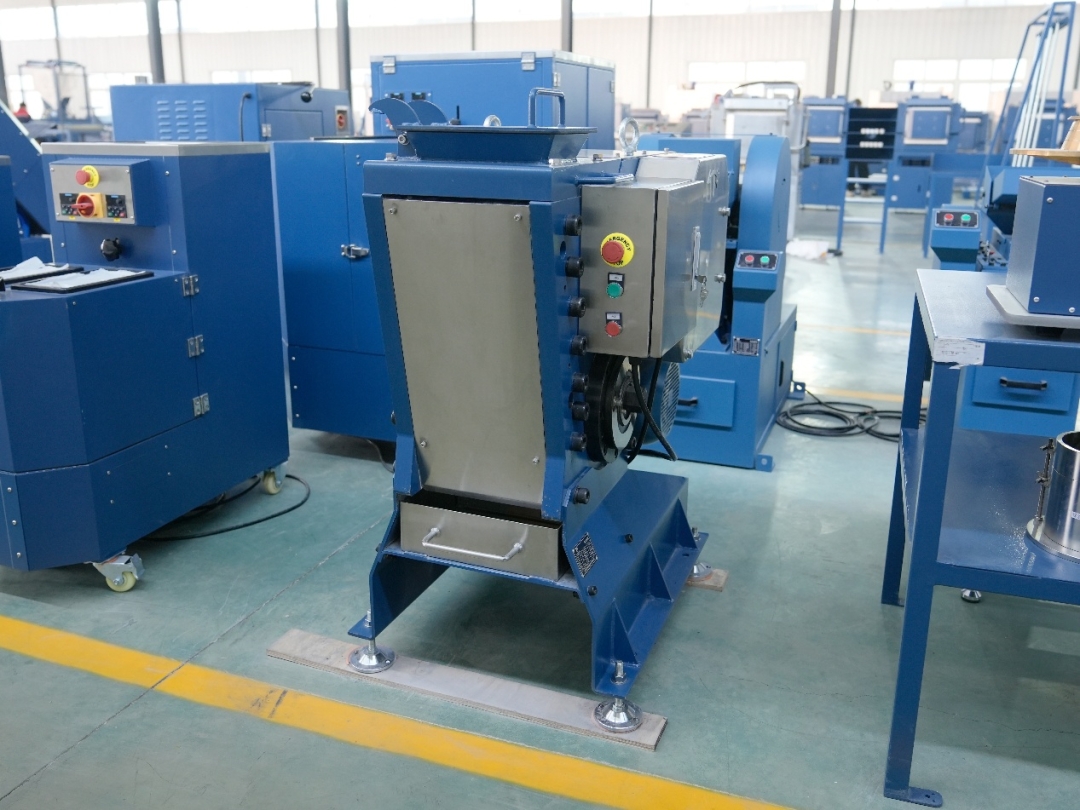
DJC-series laboratory jaw crushers built by Qingdao Decent Group incorporate tunable discharge-gap architecture covering the 4 mm-38 mm output-size range together with enclosed crushing chambers. The hardware supports flexible primary-crushing-particle-size control for diverse mineral-laboratory sample-preparation sequences.
Full technical resource: https://www.decent-group.com/product/lab-jaw-crusher/
Within global ISO/IEC 17025 mineral-testing frameworks, representative sample-preparation underpins credible resource evaluation and commodity-trade decision-making. Primary coarse-crushing is more than just lump-size reduction. Tunable discharge-gap control delivers deliberate particle-size management at the very start of the workflow.
Laboratories should evaluate jaw-crusher performance not only on throughput and mechanical robustness, but also on how consistently real-world particle-size output matches target process requirements. Adjustable gap capability delivers tangible quality-control benefits only when paired with wear-resistant consumables, adequate chamber containment and post-crushing sieve-based verification procedures. Matching particle-size-control performance to actual ore-matrix diversity and downstream-instrument constraints prevents hidden systematic bias long before samples reach analytical instrumentation.
About Us
Qingdao Decent Group is a global high-tech enterprise specializing in innovative mineral laboratory equipment and systems. With strong R&D, advanced manufacturing, and worldwide service capabilities, DECENT delivers efficient, precise, and sustainable laboratory solutions, including fire assay equipment, sample-preparation systems, and containerized mobile labs.
Media Contact
Company Name: Qingdao Decent Electromechanical Tech Co., Ltd.
Contact Person: DECENT
Email: Send Email
Country: China
Website: https://www.decent-group.com
Press Release Distributed by ABNewswire.com
To view the original version on ABNewswire visit: Adjustable Discharge Gap in Laboratory Jaw Crushers: Controlling Particle-Size for Robust End-to-End Mineral Sample-Preparation