Charitable Donation Receipt Photos Can Now Be Attached to Each Gift in Deductible Duck’s Donation Tracker
Charitable donation receipts, including Goodwill and Salvation Army drop-off slips, are photographed in the app and
Press Release Disclaimer: This is a press release distributed through the XPR Media network. It has not been independently verified by our newsroom.
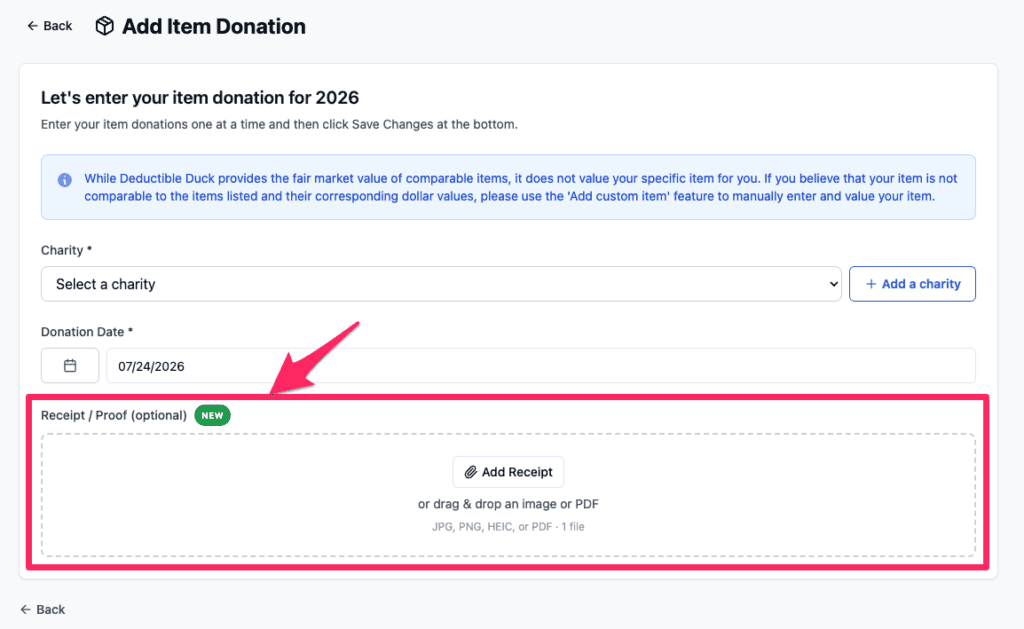

Charitable donation receipts, including Goodwill and Salvation Army drop-off slips, are photographed in the app and stored with the item list and values.
LITTLETON, CO, UNITED STATES, September 29, 2026 /EINPresswire.com/ — Charitable donation receipts can now be photographed and attached to individual donations in Deductible Duck, the charitable donation tracker built as a replacement for Intuit’s discontinued ItsDeductible. The feature is live on the paid plan. Each item donation holds one photo or PDF of its receipt, stored with the item list and the values for that gift.
To attach a receipt, a user fills in the items for a donation, scrolls down to the section labeled Receipt / Proof, and either drags in a file or, on a phone, takes the photo on the spot. The company’s help article on how to attach a charitable donation receipt to a donation walks through the steps and lists JPG, PNG, HEIC and PDF as the accepted files, at up to 10 MB each. The limit is one attachment per item donation. A drop-off that produced several receipts goes in as a single PDF. Attached files open inside the app and are private to the account that uploaded them.
The same article says photo attachments are embedded in the item donation report PDF the app builds, and a PDF attachment is noted on that report. It also says every receipt comes along in the ZIP file when a user exports their data. Attachments are a paid feature and work on item donations only.
The IRS asks for more proof as a gift gets larger. IRS Topic No. 506 says a cash gift of any amount needs a bank record or a written communication from the charity showing the charity’s name, the amount and the date. Once a gift reaches $250, cash or property, the same topic calls for a written acknowledgment from the charity, and the acknowledgment has to say whether the donor got anything in return. For property, the IRS Form 8283 instructions require Form 8283 when the deduction for noncash gifts is more than $500. Section A is for items and groups of similar items valued at $5,000 or less, and Section B, with a qualified appraisal, is for anything above that.
A bag of clothes worth less than $250 still needs a charitable donation receipt. IRS Publication 526 and the regulation behind it, 26 CFR 1.170A-13, say the receipt from the charity has to show its name, the date and place of the gift, and a description of what was given. The only time a receipt is excused is when getting one is impractical, and the regulation’s example is property left at a charity’s unattended drop site. Even then the donor keeps a written record of the charity, the date, the place and the items. Publication 526 has one more rule for clothing and household items: they have to be in good used condition or better to be deducted. The one exception is a single item appraised at more than $500.
The receipt a donor gets at a Goodwill or Salvation Army drop-off counts as long as it shows the charity, the date and place, and what was given. Goodwill of Colorado, for example, gives donors a receipt form with space to list each item and assign it a value themselves. Its donation page says IRS regulations prohibit charities from establishing or affirming the value of contributions. The company’s guide to the Goodwill donation receipt covers what the receipt has to show and where to find the charity’s tax ID. Deductible Duck suggests those values from its own item database, with a medium and a high figure for each item. Its Goodwill donation value guide shows the same ranges for common items.
“Having the receipt from the drop off proves your donation happened, and our database helps estimate the value. In April, you can easily find both in Deductible Duck,” said Dave Rodenbaugh, founder of Deductible Duck.
Intuit shut ItsDeductible down on October 21, 2025, the date in Intuit’s shutdown notice to users as quoted on the TurboTax Community on September 3, 2025. Former users can import their ItsDeductible CSV files into Deductible Duck, which tracks item, cash, stock and mileage donations. Its pricing page lists exports for TurboTax and PDF reports for a CPA. Tracking the first $1,000 of donations is free and does not require a credit card, and the paid plan costs $29.99 a year, as published on the Deductible Duck homepage.
Q: How much can you claim in charitable donations without receipts?
A: For cash gifts under $250, a bank record can take the place of a receipt. IRS Topic No. 506 says every cash gift, whatever the amount, needs a bank record or a written communication from the charity showing its name, the amount and the date, so a canceled check or a card statement works. For donated goods, Publication 526 requires a receipt unless getting one is impractical, such as at an unattended drop site. Even then the donor keeps a written record of the charity, the date, the place and the items. Any gift of $250 or more, cash or goods, needs a written acknowledgment from the charity.
Q: Does Goodwill give donation receipts?
A: Yes. Goodwill of Colorado, for example, provides a receipt form on its donation page for the donor to list each item and assign a value. It notes that IRS regulations keep charities from setting or confirming values. A donor who photographs the receipt at the drop-off can attach it to that donation in Deductible Duck.
Q: What should a donation receipt include?
A: For donated goods, Publication 526 and Treasury Regulation 1.170A-13 call for the charity’s name, the date and location of the gift, and a description of the items in reasonable detail. For any gift of $250 or more, the charity’s written acknowledgment must also say whether it gave the donor any goods or services in return. If it did, the acknowledgment gives a good faith estimate of their value, under IRS Topic No. 506. The value of donated items comes from the donor, so the receipt does not need to show it.
Q: Do I need a receipt for donations under $250?
A: Yes, for donated goods, unless it is impractical to get one, such as leaving items at an unattended drop site. Then a written record of the charity, the date, the place and what was given takes its place, under Publication 526 and Treasury Regulation 1.170A-13. For cash gifts under $250, a bank record such as a canceled check or a card statement satisfies IRS Topic No. 506.
About Deductible Duck
Deductible Duck is a charitable donation tracker for people who donate clothing, furniture and household goods and want the records the IRS asks for at tax time. Built as a replacement for Intuit’s ItsDeductible, which Intuit shut down on October 21, 2025, it values donated items with fair market value data reviewed by a person, imports ItsDeductible files, attaches receipt photos to item donations, and exports the year for tax filing. Deductible Duck is a trade name of Skyline Consulting, a Littleton, Colorado company that also makes ExpenseDuck. Deductible Duck is not affiliated with Intuit, TurboTax or ItsDeductible. Learn more at https://deductibleduck.com.
Dave Rodenbaugh
Deductible Duck
daver@deductibleduck.com
Visit us on social media:
LinkedIn
Legal Disclaimer:
EIN Presswire provides this news content “as is” without warranty of any kind. We do not accept any responsibility or liability
for the accuracy, content, images, videos, licenses, completeness, legality, or reliability of the information contained in this
article. If you have any complaints or copyright issues related to this article, kindly contact the author above.

Media gallery